Cracking the Code: Adverse Possession against land owned by T’sos and T’ongs

Landowners of T’so and T’ong land in the New Territories may face challenges when squatters assert adverse possession claims against them. It is crucial for T’sos and T’ongs to understand the legal framework and common issues that arise in defending such claim.
In this article, Ross Yuen and Eunice Lui address some common issues in adverse possession against land owned by T’sos or T’ongs, including (1) the proper party to be sued, (2) new born interests, and (3) mentally unsound members of the T’so.
The Proper Party to be Sued
It is important to first understand what a T’so or T’ong is and identify the proper party to be sued.
A T’so or T’ong is a type of Chinese customary landholding preserved in the New Territories by the New Territories Ordinance (Cap. 97). In gist, a T’so is an ancient Chinese institution of ancestral landholding whereby land derived from a common ancestor is enjoyed by his male descendants for the time being living for their lifetimes and so from generation to generation indefinitely: Tang Kai Chung & Another v Tang Chik Shang [1970] HKLR 276 at pp.279-280. Meanwhile, a T’ong can be described as a trust, which may be created by the landowner in his lifetime, for his male descendants from time to time: Chu Tak Hing & Ors v Chu Chan Cheung Kiu & Ors [1968] HKLR 542. Pursuant to section 15 of the New Territories Ordinance (Cap. 97), such T’so or T’ong shall appoint a manager to represent it. It is considered to be a trust and the registered managers are trustees within the meaning of the Trustee Ordinance (Cap.29): Tang Kai Chung (supra) at p.304.
T’sos and T’ongs are not legal entities, and therefore, the proper parties to be sued are the managers of the T’ong: Tang Yau Yi Tong and Anor v Tang Mou Shao T’so and Others [1996] 2 HKLR 212 at 219E per Liu JA.
If one of the managers passed away, the surviving manager(s) have to be sued. For example, in Chu Nam Yun v Lau Kwai Ying [2025] HKDC 842, the surviving manager of the Chu Nam Yun sued on behalf of all members of Chu Nam Yun.
New Born Interests
Each member has a life interest in T’so property, and such interest arose automatically by birth, and extinguished automatically upon the member’s death: Leung Kuen Fai v Tang Kwong Yu (or U) T’ong or Tang Kwong Yu Tso [2002] 2 HKLRD 705 at [24] per DHCJ Lam (as he then was).
In light of this peculiar characteristic, a person in adverse possession could not extinguish the title of the T’so unless he could establish the requisite limitation period against all the living members of the T’so. This is because a new equitable interest stems from each new member being admitted upon birth by reason of his hereditary link with the focal ancestor: Tsang Kwong Kuen v Hau Wai Keung Gaius [2014] 5 HKLRD 622 at [5] per Lam V-P (as he then was).
This is due to the operation of section 22 of the Limitation Ordinance (Cap 347), which reads:
“If on the date when any right of action accrued for which a period of limitation is prescribed by this Ordinance, the person to whom it accrued was under a disability, the action may be brought at any time before the expiration of 6 years from the date when the person ceased to be under a disability or died, whichever event first occurred, notwithstanding that the period of limitation had expired…”
Disability is further explained in section 22(3) of the Limitation Ordinance:
“For the purposes of this section and section 22A, a person shall be deemed to be under a disability while he is an infant or of unsound mind…”
The practical implication is that if the limitation period has not expired and there is a new born, a new limitation period under sections 7(2) and 22 Limitation Ordinance would start to run. Therefore, the title would not extinguish so long as there is at least one beneficial owner whose right to recover the land was not time-barred.
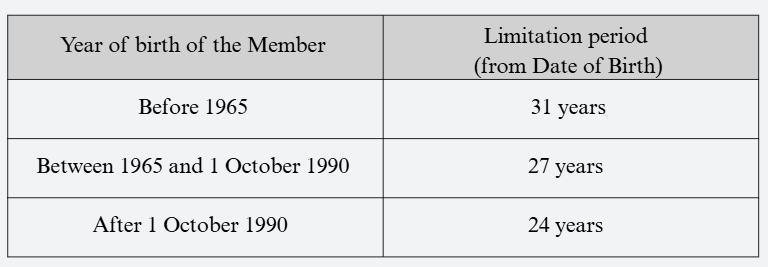
Among the members of the T’so, depending on their respective years of birth, the limitation periods could be different for different members. The method of calculating the relevant limitation period when new members were born in different years has been summarised in Leung Kuen Fai at [3] per DHCJ Lam (as he then was), which was confirmed by the Court of Appeal in Tsang Kwong Keun and has become settled law and consistently applied ever since.
According to Leung Kuen Fai at [3], the limitation periods are as follows:
It should be noted that, for hereditary institutions like T’sos and T’ongs, usually, courts will not require the register of members to be kept in the same manner as the register for large commercial corporations, and the court will not reach any other conclusion on the register of members unless the other party adduced any evidence in contradiction: Tsang Kwong Kuen at [8]-[9].
Mentally Unsound Members
Mental unsoundness is also a disability under section 22 of the Limitation Ordinance. For the purposes of section 22, mental unsoundness “does not have to be of unsound mind in the sense of mental patient” but includes persons who could not manage his affairs: Yeung Sea Chun v Director of Legal Aid (HCA 8439/1996, unrep., 28 July 2000) at pp.11-12 per Waung J.
In the English Court of Appeal decision of Kirby v Leather [1965] 2 QB 367, Lord Denning discussed the meaning of unsound mind within section 31(2) of the Limitation Act 1939, from which our section 22 is modelled from. The two sections are exactly the same, and both the Limitation Act 1939 and the Limitation Ordinance (Cap. 347) did not define “unsound mind”. In Kirby, Lord Denning adopted a liberal approach and held at 383E-384E that:
“The words“unsound mind” are not defined in this statute. Nor are they in many statutes. It seems to me that the words “of unsound “mind” in a statute must be construed in relation to the subject matter with which the statute is dealing. In Whysall v. Whysall, Phillimore J. held that the phrase “unsound mind” in a statute relating to dissolution of marriage must be taken to describe a mental state which would justify a dissolution of the marriage tie, that is, mental incapacity such as to make it impossible for a couple to live a normal married life together. So here it seems to me in this statute a person is “of unsound mind” when he is, by reason of mental illness, incapable of managing his affairs in relation to the accident as a reasonable man would do.” (emphasis added)
This must also be read against the objective of section 22:
“[T]he object of s 22 of the Limitation Ordinance must be to protect those who lack the capacity to appreciate the nature and extent of his claim and the ability to exercise reasonable judgment in relation to his claim, so that time does not start to run against them until the disability ceases and the meaning of the term “disability” should be construed accordingly.”
See: Jack Hui Fung v Shum Yee Mee (DCCJ 795/2009, unrep., 2 February 2016) at [44]-[47] per DDJ Ho.
However, it should be noted that the mental illness in question must be present when the cause of action accrues: see Jourdan on Adverse Possession at [17-11].
Conclusion
It is pertinent for T’sos and T’ongs to note the above, and particularly the implications on the relevant limitation periods in defending squatters’ adverse possession claims. Some practical considerations include ensuring the managers are properly prepared to defend these adverse possession claims, and to ensure that an accurate record of birth dates and register of members are kept in order to assert new born interests as a defence.
Authors: Ross Yuen, Eunice Lui.
Ross Yuen

Ross has his practice mainly in property law (including Chancery, Trust and Probate) and commercial law. He regularly acts in compulsory sale and adverse possession cases. Advising on other land related matters such as conveyancing, building management and tenancy is also his regular practice.
Visit Ross’s profile for more details.
Eunice Lui

Eunice was called to the Bar in 2024 and joined Chambers in the same year. Eunice is developing a broad civil practice, with particular emphasis on land-related matters. Eunice has recently appeared in two compulsory sale cases with Ross, in which one case concerns a building in Wong Nai Chung Road, and the other case being Tai Chung Property Ltd v Chen Lan Sum Irene (LDCS 4000/2023) [2025] HKLdT 40, which involves a building erected under the old Civil Servants’ Cooperative Building Society Scheme. Eunice accepts instructions in all areas of Chambers’ work.
Visit Eunice’s profile for more details.
This article was first published on 26 August 2025.
Disclaimer: This article does not constitute legal advice and seeks to set out the general principles of the law. Detailed advice should therefore be sought from a legal professional relating to the individual merits and facts of a particular case. The photographs which appear in this article are included for decorative purposes only and should not be taken as a depiction of any matter to which the case is related. The views and opinions expressed in this article/material are solely those of the members authoring it and do not necessarily reflect the official policy or position of Denis Chang’s Chambers, or of any other member or members of Denis Chang’s Chambers.